
AirAsia's group CEO Tony Fernandes, left, and Airbus President & CEO Fabrice Bregier signed the deal in the U.K.
KUALA LUMPUR -- Confidence has returned to AirAsia, the region's largest budget carrier by fleet size. Group Chief Executive Tony Fernandes has gotten more involved in running the airline group, charting a new course for expansion that may include a second listing, in Hong Kong, and a joint venture in China.
Nearly 20 months after one of its jetliners crashed into the Java sea, claiming 162 lives, Fernandes is aggressively charging toward a new phase of growth.
On July 12, AirAsia announced an order of 100 Airbus A321neo passenger aircraft. The deal, AirAsia's biggest since the accident, was announced during the biannual Farnborough Air Show, on the outskirts of London. The purchase lays bare a bold expansion plan for the no-frills flyer that in 2015 had 172 aircraft.
"With these aircraft," Fernades said during the signing ceremony, "we will hit 100 million passengers in the not-too-distant future."
The group, which has associate carriers in India, Indonesia, the Philippines and Thailand, ferried 51 million travelers last year.
In Farnborough, Fernandes was at ease. His casual attire included his trademark red baseball cap and a pair of jeans. He peppered the post-signing ceremony press conference with jokes. Fabrice Bregier, Airbus' president and CEO, was also on hand.
The new aircraft have a total catalog price of $12.6 billion. Deliveries are to begin in 2019. The A321neos have better fuel efficiency and are more spacious than AirAsia's current A320s. Fernandes has big plans for them.
Fernandes, a former executive of record company Warner Music Group, began his airline in 2001 after being inspired by the success of Ireland's Ryanair, which covers much of Europe.
Fernandes' no-frills business model, from which he has never strayed, made air travel and faraway vacations affordable to many Southeast Asians.
Of course, he never saw the Java Sea tragedy coming.
Nearly 20 months after one of its jetliners crashed into the Java sea, claiming 162 lives, Fernandes is aggressively charging toward a new phase of growth.

"With these aircraft," Fernades said during the signing ceremony, "we will hit 100 million passengers in the not-too-distant future."
The group, which has associate carriers in India, Indonesia, the Philippines and Thailand, ferried 51 million travelers last year.
In Farnborough, Fernandes was at ease. His casual attire included his trademark red baseball cap and a pair of jeans. He peppered the post-signing ceremony press conference with jokes. Fabrice Bregier, Airbus' president and CEO, was also on hand.

The new aircraft have a total catalog price of $12.6 billion. Deliveries are to begin in 2019. The A321neos have better fuel efficiency and are more spacious than AirAsia's current A320s. Fernandes has big plans for them.
Fernandes, a former executive of record company Warner Music Group, began his airline in 2001 after being inspired by the success of Ireland's Ryanair, which covers much of Europe.
Fernandes' no-frills business model, from which he has never strayed, made air travel and faraway vacations affordable to many Southeast Asians.
Of course, he never saw the Java Sea tragedy coming.
"My heart is filled with sadness for all the families involved in Flight 8501," Fernandes tweeted on Dec. 30, 2014, two days after the crash. "Words cannot express how sorry I am."
While AirAsia was dealing with the tragedy, it was also grappling with intense competition. Other budget carriers appeared in the skies, and fares fell. Amid all this, the group was accused of tweaking figures to boost earnings. As a result, the company's stock price last August caved in, falling to a low of 0.78 ringgit.
"Many people were writing off AirAsia, but we stuck to our guns," Fernandes recalled in Farnborough. "We have moved from a Southeast Asian airline to an Asian airline."
And AirAsia's share price has bounced back. On Tuesday, the shares closed at 2.95 ringgit, the highest they've been since two days before the crash. Cheaper fuel prices, which have buoyed the entire aviation industry, and a reshuffling of routes have contributed to the recovery.
The shares finished the week at 2.97 ringgit.
Market capitalization grew by about 7% to $2.03 billion since the crash, but still lacked behind regional peers like Shanghai-based Spring Airlines' $5.89 billion.
According to the Centre for Aviation, or Capa, an Australian consultancy, among the 20 regional airlines in Southeast Asia, 14 reported year-over-year improvements in the first quarter 2016, including all seven of the AirAsia-branded airlines. "The group is upbeat about its outlook, having recovered from a very challenging 2015," Capa added.
After the accident, Fernandes kept a low profile. Only now is he re-emerging. "Super second quarter performance for All Stars," he tweeted on Jul. 27, giving employees credit for AirAsia's strong passenger growth in the April-June period.
AirAsia said it carried 13.9 million travelers during the quarter, 12% more than a year earlier, despite the April-June period traditionally being "our slowest quarter," Fernandes said.
The bumper passenger numbers are thanks to higher demand in Malaysia and Thailand.
By way of comparison, AirAsia's closest rival in the region, Cebu Pacific Air, out of the Philippines, carried 5.2 million in the quarter.
Ten new routes were added during the quarter, mainly to second-tier Chinese cities, which now account for about 40% of revenue. AirAsia also increased the frequency it flies to many of its destinations.
The group is to announce its latest earnings by the end of the month.
In the 20 months since the accident, AirAsia has undergone operational and structural changes.
Fernandes gave up the carrier's ASEAN headquarters, in Jakarta, and put it back in Kuala Lumpur. The CEO had hoped the Jakarta base would lead to growth in Indonesia and the surrounding region.
In April, Fernandes received shareholder approval to raise his stake in AirAsia from 18.9% to 32.4% through Tune Live, a private company co-owned with Kamarudin Meranun, who co-founded AirAsia with Fernandes. The new share issuance will raise 1 billion ringgit ($247 million), which will be used to pare debt and as capital expenditures.
The AirAsia Group's net debt after offsetting cash balances amounted to 9.2 billion ringgit as of March.
"The placement signals the conviction of the major shareholders with regard to the prospects of AirAsia, given the sizable cash outlay and expanded share base of the group," said Marvin Khor of AllianceDBS Research. He added that the capital injection will reduce the carrier's gross debt-to-equity ratio from 2.8 to 2.2, raising its stock valuation.
After the Airbus order, Fernandes traveled to the U.S. and Europe to let institutional investors like Fidelity and The Boston Company Asset Management know that they might want to kick AirAsia's tires. Perhaps they'll find a bargain.
From Paris, Fernandes tweeted, "15 days but very rewarding for me and investors now know how undervalued we are."
To be a bargain, though, the shares have to look like they are ready to jump in price. In other words, AirAsia needs to continue growing.
That is not going to happen in Southeast Asia. Budget short-haul routes there have approached "maturity," Capa said in a report earlier this year. Low-cost carriers made up of 56% of the seats flown in the region, compared to 11% in Northeast Asia.
For AirAsia, then, growth means going north.
To drive growth in China and Japan, AirAsia in June set up North Asia, a Hong Kong-based subsidiary.
The president is Kathleen Tan, who was in the music industry before 2004, when she was named AirAsia's commercial director. She was promoted in 2013 to head of AirAsiaExpedia, a joint venture with a travel agency that AirAsia has since divested.
"North Asia -- with China, South Korea, Japan and Taiwan -- is considered a high growth region" for no-frills flyers, Tan told the Nikkei Asian Review. Tan said demand for regional travel is high, partly due to the proximity of the countries and cultural similarities.
Tan's top priority is China. China's budget aviation market is growing rapidly. A raft of new players entered the skies after the government began opening new routes to promote economic growth in the western part of the country. Spring Airlines and West Air enjoy big pieces of China's low-coast market.
Fernandes said he will pursue more connections to second-tier Chinese cities.
"I can confirm China is a market we will love to be in," he said. "We are not interested in Beijing or Shanghai or those big metropolises. What AirAsia is good at is developing those secondary and tertiary routes, and those are what we are looking at."
Fernandes continued that AirAsia's forte is "providing connectivity where there isn't any connectivity and providing economic growth where there isn't any economic growth."
The strategy is to avoid directly competing with both full-service and budget carriers that have already established hubs in the country. AirAsia might do this by taking the joint venture route. He said AirAsia has been approached by Chinese companies in this regard.
Hong Kong's capital market could also beckon AirAsia.
"We need to attract a new form of capital and awareness of AirAsia," Fernandes said in Farnborough, adding that a Hong Kong listing could help AirAsia accomplish these goals. "It is something we are investigating," he said.
The carrier is also getting ready to start crisscrossing Japan again. It has received two A320s, and Tan said the group hopes to begin test flights this month.
Pending regulatory approval, it hopes to begin commercial flights from its base in Nagoya come January.
It will have to compete against established peers like Peach in Japan and Spring Airlines in China, and the relatively demanding customers in North Asia who may have yet to be fully accustomed to no-frills travels.
"While I joke and laugh but it is not easy," Fernandes said in response to a question on how he manages challenges in different markets.
"To me, business is the same whether it is in an airline or music: Maximize the top line, minimize the cost, do a lot of marketing and be different."
While AirAsia was dealing with the tragedy, it was also grappling with intense competition. Other budget carriers appeared in the skies, and fares fell. Amid all this, the group was accused of tweaking figures to boost earnings. As a result, the company's stock price last August caved in, falling to a low of 0.78 ringgit.
"Many people were writing off AirAsia, but we stuck to our guns," Fernandes recalled in Farnborough. "We have moved from a Southeast Asian airline to an Asian airline."

And AirAsia's share price has bounced back. On Tuesday, the shares closed at 2.95 ringgit, the highest they've been since two days before the crash. Cheaper fuel prices, which have buoyed the entire aviation industry, and a reshuffling of routes have contributed to the recovery.
The shares finished the week at 2.97 ringgit.
Market capitalization grew by about 7% to $2.03 billion since the crash, but still lacked behind regional peers like Shanghai-based Spring Airlines' $5.89 billion.
According to the Centre for Aviation, or Capa, an Australian consultancy, among the 20 regional airlines in Southeast Asia, 14 reported year-over-year improvements in the first quarter 2016, including all seven of the AirAsia-branded airlines. "The group is upbeat about its outlook, having recovered from a very challenging 2015," Capa added.
After the accident, Fernandes kept a low profile. Only now is he re-emerging. "Super second quarter performance for All Stars," he tweeted on Jul. 27, giving employees credit for AirAsia's strong passenger growth in the April-June period.
AirAsia said it carried 13.9 million travelers during the quarter, 12% more than a year earlier, despite the April-June period traditionally being "our slowest quarter," Fernandes said.
The bumper passenger numbers are thanks to higher demand in Malaysia and Thailand.
By way of comparison, AirAsia's closest rival in the region, Cebu Pacific Air, out of the Philippines, carried 5.2 million in the quarter.
Ten new routes were added during the quarter, mainly to second-tier Chinese cities, which now account for about 40% of revenue. AirAsia also increased the frequency it flies to many of its destinations.
The group is to announce its latest earnings by the end of the month.
In the 20 months since the accident, AirAsia has undergone operational and structural changes.
Fernandes gave up the carrier's ASEAN headquarters, in Jakarta, and put it back in Kuala Lumpur. The CEO had hoped the Jakarta base would lead to growth in Indonesia and the surrounding region.

In April, Fernandes received shareholder approval to raise his stake in AirAsia from 18.9% to 32.4% through Tune Live, a private company co-owned with Kamarudin Meranun, who co-founded AirAsia with Fernandes. The new share issuance will raise 1 billion ringgit ($247 million), which will be used to pare debt and as capital expenditures.
The AirAsia Group's net debt after offsetting cash balances amounted to 9.2 billion ringgit as of March.
"The placement signals the conviction of the major shareholders with regard to the prospects of AirAsia, given the sizable cash outlay and expanded share base of the group," said Marvin Khor of AllianceDBS Research. He added that the capital injection will reduce the carrier's gross debt-to-equity ratio from 2.8 to 2.2, raising its stock valuation.
After the Airbus order, Fernandes traveled to the U.S. and Europe to let institutional investors like Fidelity and The Boston Company Asset Management know that they might want to kick AirAsia's tires. Perhaps they'll find a bargain.
From Paris, Fernandes tweeted, "15 days but very rewarding for me and investors now know how undervalued we are."
To be a bargain, though, the shares have to look like they are ready to jump in price. In other words, AirAsia needs to continue growing.
That is not going to happen in Southeast Asia. Budget short-haul routes there have approached "maturity," Capa said in a report earlier this year. Low-cost carriers made up of 56% of the seats flown in the region, compared to 11% in Northeast Asia.
For AirAsia, then, growth means going north.
To drive growth in China and Japan, AirAsia in June set up North Asia, a Hong Kong-based subsidiary.
The president is Kathleen Tan, who was in the music industry before 2004, when she was named AirAsia's commercial director. She was promoted in 2013 to head of AirAsiaExpedia, a joint venture with a travel agency that AirAsia has since divested.
"North Asia -- with China, South Korea, Japan and Taiwan -- is considered a high growth region" for no-frills flyers, Tan told the Nikkei Asian Review. Tan said demand for regional travel is high, partly due to the proximity of the countries and cultural similarities.
Tan's top priority is China. China's budget aviation market is growing rapidly. A raft of new players entered the skies after the government began opening new routes to promote economic growth in the western part of the country. Spring Airlines and West Air enjoy big pieces of China's low-coast market.
Fernandes said he will pursue more connections to second-tier Chinese cities.
"I can confirm China is a market we will love to be in," he said. "We are not interested in Beijing or Shanghai or those big metropolises. What AirAsia is good at is developing those secondary and tertiary routes, and those are what we are looking at."
Fernandes continued that AirAsia's forte is "providing connectivity where there isn't any connectivity and providing economic growth where there isn't any economic growth."
The strategy is to avoid directly competing with both full-service and budget carriers that have already established hubs in the country. AirAsia might do this by taking the joint venture route. He said AirAsia has been approached by Chinese companies in this regard.
Hong Kong's capital market could also beckon AirAsia.
"We need to attract a new form of capital and awareness of AirAsia," Fernandes said in Farnborough, adding that a Hong Kong listing could help AirAsia accomplish these goals. "It is something we are investigating," he said.
The carrier is also getting ready to start crisscrossing Japan again. It has received two A320s, and Tan said the group hopes to begin test flights this month.
Pending regulatory approval, it hopes to begin commercial flights from its base in Nagoya come January.
It will have to compete against established peers like Peach in Japan and Spring Airlines in China, and the relatively demanding customers in North Asia who may have yet to be fully accustomed to no-frills travels.

"While I joke and laugh but it is not easy," Fernandes said in response to a question on how he manages challenges in different markets.
"To me, business is the same whether it is in an airline or music: Maximize the top line, minimize the cost, do a lot of marketing and be different."


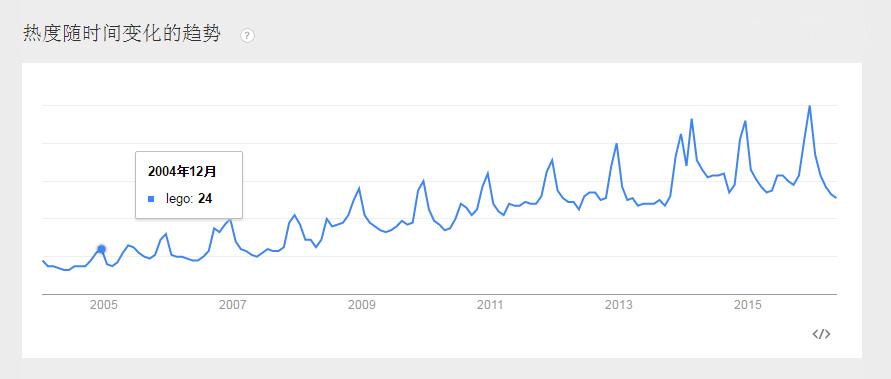
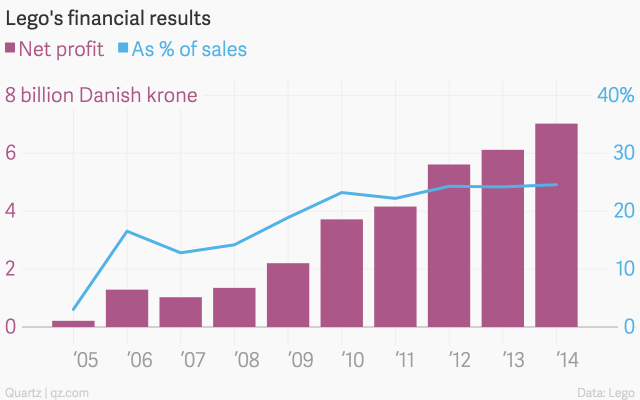 看到 2005 年财报的 net profit 是 2.14 亿丹麦克朗,而 2014 年这个数字是 70 亿克朗。

 上面也有人提到了乐高大电影,确实牛逼啊,这动画电影不光是拍给熊孩子看的!能把品牌嵌入电影还不惹人讨厌,也就乐高能干得出来,这简直就是个巨大的品牌广告片!段子够逗逼,乐高人仔的渲染非常细腻,关键是结尾确实完美植入了品牌理念。一部电影,转化成了实实在在的巨额销量,攒新粉丝的效果惊人,14年上半年因为电影提振,销量直涨11%。乐高大电影还会有2,就是不知道大陆会不会引进。
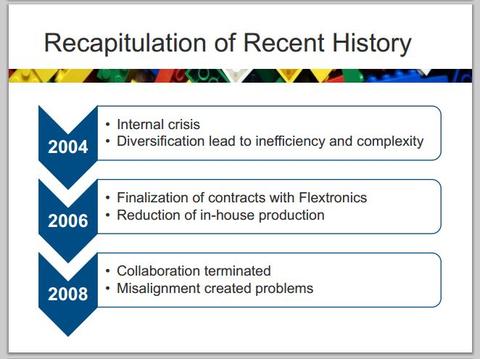 我来试着回答一下05~09年那波动的净利润......那几年Lego的大动作如下:04年,全球第五大玩具制造商Lego集团与电子制造服务提供商Flextronics(伟创力)签订长期协议,外包模型、组装、包装和运输(modeling, assembly, packaging and distribution)以期降低…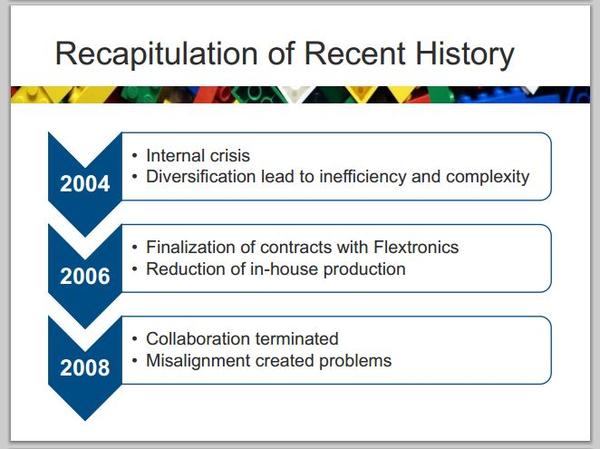
 从数学角度来说,如果你有六块八颗凸起的乐高长方体积木,可以砌出一亿种组合。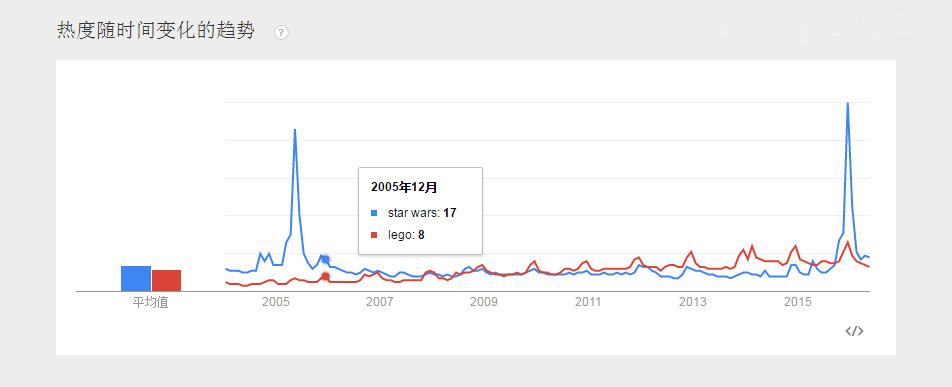
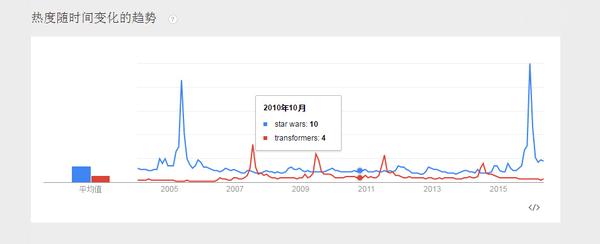 我们注意到:


 猜猜这是什么?乐高全球CEO的名片(读音是姚根儿,后面还会讲他),在背面印着姚根儿的座机和email。这个人偶的脖子,腿,胳膊,和手都是都是可以拆卸可以转的,连头发都可以转可以拆下来,所以转到90°的时候,CEO的眼睛会被挡住而风中凌乱,时尚时尚最时…

 姚根儿挺帅的不是么?


